
How to Play Scavland
Read the world before you shoot it.
Scavland looks like a pixel-art action game and plays like a survival RPG with a notebook. If you skip the interface, Zalesye feels unfair. If you learn it, the same systems become a loop you can plan around. This page is the rules of play, not a story walkthrough. Pair it with Getting Started for the first hour and controls for the key list.
The camera and the body
The view is top-down. Public footage does not spin the world like an isometric tactics game; you move the Vulture through a fixed orientation and zoom with aimed fire rather than a free camera orbit. That matters in combat. Cover is a sprite edge, not a third-person shoulder. Right-click zoom is used as a poor man’s ADS: slower, tighter, better for not wasting rifle ammo.
Movement is the usual WASD pattern in keyboard videos, with a run that costs you attention more than stamina numbers. You will be hungry, thirsty, irradiated, or bleeding while you run. Speed is not free. Crouch and stealth options exist in later systems NoShadow listed as takedowns; see stealth once you can stand still without starving.
Journal, map, and jobs
Press J for the quest book. It is a book. Contracts, main beats, and side work live there with icons for items and objectives after the job-system rework. Do not trust memory. Zalesye is large enough that a half-heard Mudlark warning becomes a wasted walk.
The Steam page promises a dynamic minimap and a world map. Use them like a stalker would: mark the return path first. Distance on a job raises pay. It also raises the number of things that can happen before you cash in. Human squad hunts and rare-item retrievals can spawn across the map; farther is richer and dumber for a fresh save.
Jobs are how you meet factions without writing a thesis. A kill list of small rats, a placenta vial, a corpse that must be reported northwest: those are the texture of Act I. Turn them in. Rank at traders unlocks stock. That loop is the real tutorial.
Inventory is the game
Scavland is an inventory manager that lets you shoot. Backpacks have weight and slots. Creators drop the pack on the ground to sort. That animation is cute and also the correct mindset: you are a person rummaging, not a HUD vacuum.
Keep:
- Medical items and bandages
- Food and water
- Cleaning kits and repair tools
- Ammo that matches the gun you will actually fire
- Quest objects
Sell:
- Red cloth and vendor trash
- Duplicate broken pistols
- Heavy trophies you cannot use this trip
A bigger backpack is a quest reward in demo footage, not a shop default. Until you have it, every bottle is a decision. The starting loadout page goes item by item. Traders explains who buys what without turning you into a walking landfill.
Guns are tools with a lifespan
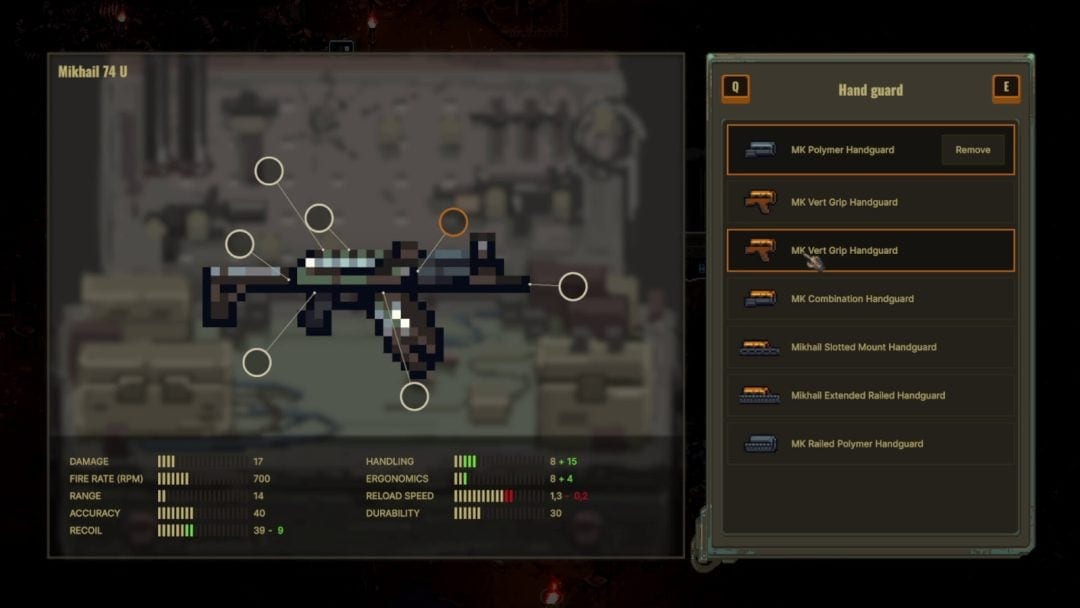
You will find an AK-pattern rifle early. You will also find homemade pistols that exist to make noise. Condition matters. Dirty weapons jam. Badly kept guns can cook off and become scrap. Cleaning kits work in the field; workbenches and rest areas are faster. That is maintenance, not optional crafting flavour. Read combat before you dump a pristine magazine into bushes, and weapon builds before you start swapping stocks you cannot replace.
Attachments are a late-beginner hobby. Early Access lists 25+ weapons and 300+ parts: stocks, magazines, optics, muzzles, grips. You do not need a meta build to leave town. You need a gun that fires.
Talk, then shoot
NPCs give hints, favours, and the political weather. Some want to rebuild. Some want to eat. The Rada organises, Gunners lean ruthless, Mudlarks sit northwest and do not welcome strangers. You can work for several groups until you cannot. Reputation is the long game. Day-one play is: do not murder the only person who buys your scrap.
Stealth takedowns, suppression fire, and melee on F are all legal answers to the same corridor. How to play Scavland is choosing the cheapest answer that still gets you home.
Two clocks
There is a day-night cycle on the surface. There is also your body. Hunger and thirst do not pause because you found a bunker hatch. Radiation in water slows you the deeper you wade. Some creatures refuse the water; some chase anyway. Survival is the page for those clocks. This page only insists that you look at them.
Underground, layouts change. Bunkers are procedural. Play them like a raid with an exit plan, not like a roguelike you are happy to die in. Your save persists. So does the corpse path if you were foolish.
A session template
- Town: heal, eat, repair, read the journal, check trader rank.
- One job within a distance you can walk twice.
- Optional hatch only if you still have meds and a clean gun.
- Sell, sleep if the build allows a rest area, note what broke.
- Stop. Scavland rewards stopping.
If the UI still fights you, watch the video on this page, then skim Getting Started and the demo notes. Early Access on 4 September 2026 will add more systems than the 2025 slice, but the way you play should stay conservative. The wasteland is patient. You should be too.
Frequently Asked Questions
Quick answers to the most common questions.
How do I open quests in Scavland?
Press J to open the quest book. It tracks contracts, main quests, and side jobs. Details are on controls.
Is Scavland pause-friendly?
It is a single-player RPG with menus, inventory, and a journal. The world has a Life system that keeps NPCs and creatures busy, so do not assume the road stays empty while you AFK in a field.
Can I play Scavland with a controller?
Yes. NoShadow shipped full controller support and designed inventory and looting for Steam Deck and handhelds. Keyboard shortcuts on this wiki come from PC gameplay videos.
Is there a map?
Early Access includes a dynamic minimap and world map. Use them to plan a return path, not as a permission slip to walk farther than your food allows.